News

Investment reinforces ION as the sensible choice for PID gas sensors

ION Science, a leading global manufacturer of photoionisation detection (PID) sensors for VOC monitoring,further invests in manufacturing technologyFollowingthe recent construction ofapurpose-built £4.5 million facility, significant investment continues into buildingthe newION TechnologyCentre forfuture innovation, tomaintain ION’s position as an industry leader.This sustainable, environmentally focused facilityenhances IONs vision of protecting lives and preserving the environment.

This investment is a good example of the advantages that can be gained from being a privately owned, independent company. We are free from corporate requirements dictating what should be in our technology portfolio, and we are able to invest in our own resources for the benefit of our customers,explains Duncan Johns, Managing Director.

The expansion of ION’s facilities will further optimiseand automate critical processes in sensor manufacturing. “This will enable us to fulfil our commitment toenhance the repeatability and stabilityof our products; quality measures for which our sensors are already world-renowned.We strongly believe that the freedom to focus on qualityand standards allows us to offer the world’s best PID sensors, and with the largest global market share, it would appear that ourcustomers agree, continuesDuncan Johns, Managing Director. 

There are several key factors that underpin the levels of sensor quality that IONis able to deliver as an independent company. These are: 1) the widest range of PIDs in the world; 2) the only fail-safe PIDs on the market; 3) the best available temperature stability; 4) the best available humidity stability; and 5) the most sensitive PIDs on the market.

ION Scienceis able to assertthat it offers the world’s widest range of PIDs because, unlike those companies that adopt a ‘one-lamp-fits-all policyION designs, develops and manufactures10.0, 10.6 and 11.7 eV lamps. This is crucially important for OEMs because it means that their measurement capabilities are not restricted to compounds with an ionisation energy lower than 10.6 eV, for example.Therefore, IONcustomers are able to choose the best lamps for their applications, which improves sensitivity and widens the range of VOCs that can be measured.

Uniquely, ION’s PIDs (MiniPIDs) incorporate an ASIC chip, which continuously monitors lamp and sensor performance, providing fail-safe assurance of sensor health. The ASIC manages the sensor to give exceptionaltemperature stability to deliver a stable signal from -40 to +65oC.

Humidity is a major challenge for many PID manufacturers,however, all of ION’s MiniPIDs have patent protected design with a third electrode thatovercomes this challenge, delivering a stable signal from 0 – 99% RH.

The sensitivity of PID sensors is extremely important in many applications; particularly where the sensors are deployed in the measurement of trace VOCs.Again,ION leads the field, offering MiniPIDs with ten times the sensitivity of other PID manufacturers.

Integration support is crucially important for OEM customers, especially in the early days of their partnership with ION, so this is a key focus for the company. As the developer and manufacturer of the world’s leading PIDs, ION is able to offer support at any level, but to avoid complacency, customers are also surveyed to check that ION is meeting, andexceeding expectations.

Product cost is of course a major consideration for PID customers, and the MiniPID lamps and stacks are fully serviceable in the field. This reduces lifetime cost, which also benefits end-users.

Summarising, Duncan Johns says: “As a private company, our independence means that we are free to continuously invest in our market-leading technologiesWhen OEMsintegrate PID Sensor intheir products, it is their brand reputation that is at stake, soIONs customers benefit from the assurance that every MiniPID provideshigh quality, reliable results.For that reason, we know that when it comes to PID sensors, ION is the only sensible choice.”

Preventing Fire and Explosions Aboard Commercial Ships

Fire and explosions are among the most significant dangers aboard any sizeable vessel. This is true for all seafarers, including military, commercial, and privately owned ships. All crew members should be well trained in fire fighting, but the best training is on how to prevent fires from happening in the first place. The proper choice of portable LED lighting can reduce the risk of fire and explosions.

Three elements are needed for a fire to occur: a fuel source, oxygen, and an ignition source. The ignition source is the easiest part of this equation to remove using Intrinsically Safe (IS) lighting. So what does IS actually mean? Generally speaking, anIS-rated portable light is carefully designed and manufactured so that it cannot release enough electrical and thermal energy to ignite combustible gases or vapors. 

One of the many IS rating requirements is that lighting must be constructed of a non-sparking substance. Engineered polymer is the most commonly used material. Because of its saltwater and chemical corrosion resistance properties, this makes polymer ideal for maritime use. Additionally, IS lights must be completely waterproof, another feature sailors appreciate. Innovative Manufacturers that create lighting specifically for use aboard commercial ships also add useful features such as rare-earth magnets and dual lights. In smoke-filled environments, dual lights allows the user to activate the spotlight and downward-facing floodlight simultaneously, navigating around trip hazards while also lighting the path ahead.

The combination of magnets and a floodlight gives the ability to attach IS portable lighting to the bulkhead to operate equipment hands-free without the intense glare of a spotlight.

Because of the knowledge, time, and expense required to engineer and produce IS-certified lighting, few companies achieve this. Nightstick is a global manufacturer of over 50+ Intrinsically Safe LED lighting products used worldwide in 70+ countries. Find a distributor near you at www.nightstick.com


Hi-Plex hybrid technology from Hi-line provides cost-effective, energy-efficient compressed-air drying

Estimates suggest that Class 4 moisture content according to ISO 8573-1 is acceptable in the majority of compressed air system applications, thus supporting the use of refrigeration dryer technology. However, where applications demand higher levels of moisture removal, desiccant tends to be the go-to technology. The long-standing problem here is the higher cost associated with desiccant dryers, which is why Hi-line Industries, a UK-based leader in the design, manufacture and installation of energy-efficient compressed air purification equipment, is addressing this issue with its new Hi-Plex dual technology dryers. This hybrid solution combines Hi-line’s established refrigeration and PSA (Pressure Swing Adsorption) air treatment technologies, creating an energy-efficient system at low capital cost compared with standard heat-regeneration desiccant air dryers. 

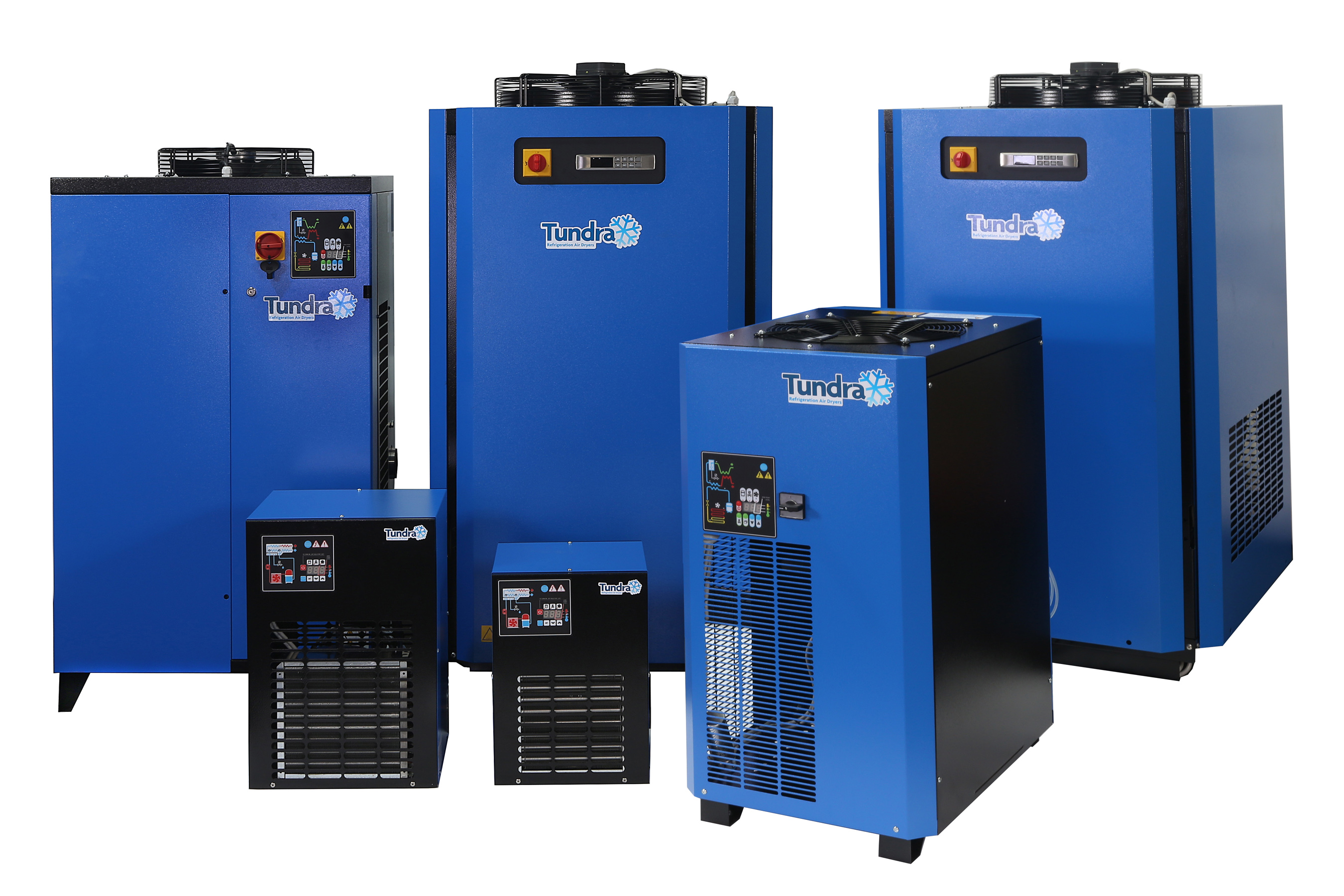
So how does Hi-Plex work? Well, a Hi-line Tundra refrigeration system first removes bulk moisture via zero loss auto-drains, after which it chills the air to +1°C in the heat exchanger, condensing out all water to a +3°C PDP (Pressure Dewpoint). From here, the pre-dried air passes into an energy-efficient HPSA (Hi-line Pressure Swing Adsorption) dryer where it is further dried via adsorption to lower dewpoints of between -20°C PDP and -70°C PDP depending on end-user requirements, meeting Class 2 moisture content in accordance with ISO8573.1. As a point of note, Hi-line can add an Activated Carbon Tower for Class 0 applications.

Hi-Plex regeneration takes place by deploying a vacuumed-assisted fan, which uses a reduced amount of purge air to cause a desorption effect within the desiccant beds. A side-channel vacuum pump removes the small amount of remaining water (via exhaust silencers) back to the atmosphere from where it came. This plug and play system is fully automatic: wet air in – dry air out.

​​​​​​​​​​​​​​Continued ……

Importantly, Hi-Plex high-performance dual technology dryers typically run at only 1-2% purge in comparison with 13-15% on a standard desiccant air dryer. Even more savings are achievable following the specification of Hi-line’s optional AEMS (Automatic Energy Management System) for dewpoint control. AEMS features a digital dewpoint readout, high-humidity alarm, and set and demand regeneration function. As a result, customers can ensure they only use a minimal amount of energy to achieve dewpoints at any given time. In total, energy savings of over 70% are achievable compared with a conventional desiccant dryer, offering far quicker return on investment (ROI).

Every Hi-Plex dual technology dryer is application-specific, but built from standard off-the-shelf Hi-line products. The company adds all the components, stainless steel pipework and filtration to a compact skid at its UK headquarters and manufacturing facility in Burton-upon-Trent. Hi-line will happily cater for any special requirements, such as even smaller footprint or lower height dimension to fit inside a low-ceiling compressor house, for example. The company can also facilitate connection to customer software or a BMS (Building Management System).

Hi-Plex systems are available from 165 to 1700 Scfm, and from 3.1 to 10.8 kW installed power. A five-year warranty is standard subject to service criteria.


Estimates suggest that Class 4 moisture content according to ISO 8573-1 is acceptable in the majority of compressed air system applications, thus supporting the use of refrigeration dryer technology. However, where applications demand higher levels of moisture removal, desiccant tends to be the go-to technology. The long-standing problem here is the higher cost associated with desiccant dryers, which is why Hi-line Industries, a UK-based leader in the design, manufacture and installation of energy-efficient compressed air purification equipment, is addressing this issue with its new Hi-Plex dual technology dryers. This hybrid solution combines Hi-line’s established refrigeration and PSA (Pressure Swing Adsorption) air treatment technologies, creating an energy-efficient system at low capital cost compared with standard heat-regeneration desiccant air dryers. 

So how does Hi-Plex work? Well, a Hi-line Tundra refrigeration system first removes bulk moisture via zero loss auto-drains, after which it chills the air to +1°C in the heat exchanger, condensing out all water to a +3°C PDP (Pressure Dewpoint). From here, the pre-dried air passes into an energy-efficient HPSA (Hi-line Pressure Swing Adsorption) dryer where it is further dried via adsorption to lower dewpoints of between -20°C PDP and -70°C PDP depending on end-user requirements, meeting Class 2 moisture content in accordance with ISO8573.1. As a point of note, Hi-line can add an Activated Carbon Tower for Class 0 applications.

Hi-Plex regeneration takes place by deploying a vacuumed-assisted fan, which uses a reduced amount of purge air to cause a desorption effect within the desiccant beds. A side-channel vacuum pump removes the small amount of remaining water (via exhaust silencers) back to the atmosphere from where it came. This plug and play system is fully automatic: wet air in – dry air out.

​​​​​​​​​​​​​​Continued ……

Importantly, Hi-Plex high-performance dual technology dryers typically run at only 1-2% purge in comparison with 13-15% on a standard desiccant air dryer. Even more savings are achievable following the specification of Hi-line’s optional AEMS (Automatic Energy Management System) for dewpoint control. AEMS features a digital dewpoint readout, high-humidity alarm, and set and demand regeneration function. As a result, customers can ensure they only use a minimal amount of energy to achieve dewpoints at any given time. In total, energy savings of over 70% are achievable compared with a conventional desiccant dryer, offering far quicker return on investment (ROI).

Every Hi-Plex dual technology dryer is application-specific, but built from standard off-the-shelf Hi-line products. The company adds all the components, stainless steel pipework and filtration to a compact skid at its UK headquarters and manufacturing facility in Burton-upon-Trent. Hi-line will happily cater for any special requirements, such as even smaller footprint or lower height dimension to fit inside a low-ceiling compressor house, for example. The company can also facilitate connection to customer software or a BMS (Building Management System).

www.hilineindustries.com


NEW Peli™ RF G5 Field Wallet – now in stock

Peli Products (UK) Ltd celebrate their 30th anniversary year in 2022.  The company is based in Glossop, Derbyshire and is the largest stockist of the Pelirange in the UK.  

Peli Products (UK) launchthe Peli™ RF G5 Field Wallet, featuring a solid aluminum RFID-blocking shell.  It is one of the only submersible aluminum wallets that protects the user’s credit card information from being stolen by hackers that use RFID (Radio Frequency Identification) scanners

This sleek, lightweight, and tough aluminum case fits comfortably in a pocket and features a silicon o-ring and sturdy snap latchit is rated IP67.

These unrivaled features make the Peli RF G5 Field Wallet the perfect everyday carry wallet or travel wallet. Additional features include:

• Flexible internal webbing that secures ID, credit cards and cash for easy access.
• A removable lanyard to protect against possible drops, loss and/or theft.
• An external strap for carrying cash or cards and instant retrieval.

Ross Carter, Sales Director for Packaging Products commented “This compact case is a fantastic addition to the ever-growing range of Peli Products, and were delighted to be able to offer this to our customers at a very reasonableprice point.The combination of military-grade tougbuild quality with technology that protects personal information from RFID reader theftaligns perfectly with the Peli brand values and offers the customer complete piece of mind when protecting their valuables.

The Peli G5 Field Wallet is covered by the legendary “Yobreak it, we replace it” Lifetime Guarantee.

 For more details ring 01457 869999 or go towww.peliproducts.co.uk

RHEINTACHO expands sales team Stefan Lenz appointed new branchmanager

Mr. Stefan Lenz has been the new business manager at the Freiburg family company RHEINTACHO Messtechnik GmbH since October 2022. This increases the capacity and competence in sales around Wolfgang Sexauer's team.

In order to increase RHEINTACHO´s markets and to take care for the growing customer portfolio, Stefan Lenz will strengthen the RHEINTACHO branch management alongside his colleagues Thomas Distel and Jörn Strasser.

In the last 12 years, Stefan Lenz has worked successfully in the field sales force and has gotten to know and gained a lot of experience from groups to family businesses. He will now be able to use the knowledge he has acquired in technical sales when dealing with our customers. Through various commercial, technical and sales training courses in sales, he is an enrichment and we warmly welcome Stefan Lenz to our team.


https://www.rheintacho.de/en/news-events/events/

Bearing Lubrication Reimagined: Remote and Real Time Friction Monitoring and Lubrication

What if we could lubricate our bearings remotely, from any device, making sure that the right amount and right lubricant are always used – and even better, based on bearing condition? Then we would address the 3 main lubrication issues which cause most of early bearing failures. Today this is already possible. Using ultrasonic sensors and single point lubrication devices, all connected to a central system, we can now bring lubrication practices to a whole new level!

Prevention in place of monitoring

We have a serious problem with bearing condition monitoring! Technology is making it easier and more cost-effective to monitor our bearings in real-time and as a result, we are seeing sensors and systems being installed on equipment at an exponential rate.  

There is a race from these monitoring systems to detect the onset of failure (Point P on the P-F curve) at the earliest possible point. And this race to detect a failure is a serious problem. We are spending more money and extra TIME to detect a failure when we should be preventing that failure in the first place.   

Addressing lubrication issues – the root of most bearing failures

It is no secret that over 80% of premature bearings failures can be traced back to lubrication related issues. These issues can be put into three general categories: inadequate lubrication (over or under lubricated), wrong lubricant, and contamination. When it comes to addressing premature bearing failure, reducing the impact on just one of these issues can have a large impact on the bearing life. But when we start to address all three, then we canreach excellence in our lubrication programs.

It’s all about the friction levels

A lot of expertise needs to be designed into the bearing selection and lubrication requirements, no technology will likely ever replace the need for trained and experienced lubrication experts.But when it boils down to it, it is all about friction - that’s why they are called anti-friction bearings.

Once the correct bearing is installed properly and the right lubricant is chosen, it comes down to managing that friction in the bearing by using the correct regreasing volume and frequency. Simple to understand but often difficult to put intopractice.

Time based lubrication vs condition-basedusing ultrasound to avoid under and over-lubrication

One technique is to use time-based lubrication. In this case, regreasing is done based on time, with a predetermined amount of grease. This method is often based on an ideal calculation that is not reflective of the real-life condition that influences the friction in the bearing. This often leads to under greasing or over greasing the bearing.

A step-change in lubrication practices came with condition-based lubrication. Using ultrasound to measure the friction in real-time to determine exactly when lubrication (and how much)is required to bring the friction back to or near the ideal level. Moving to ultrasound-assisted lubrication will ensure we do not over or under lubricate but has still not addressed the two other lubrication related issues: using the correct lubricant, and contamination.

What about automatic lubricators?

To address these two other lubrication issues many have turned to automatic lubrication devices or auto lubers. Automatic lubrication provides a safer and more convenient method of supplying the precise amount of lubricant into the bearings on a more frequent basis.

These devices ensure we always use the correct grease stored in the device but also reduce or eliminate the possibility of contamination caused by the operational environment. These devices are time-based and set to dispense lubricant on a set frequency or run time.

The auto lubricant devices have evolved to become smarter. Many of them not only dispense the lubricant but can also set alarms based on excessive feedback and low lubricant.

The best of two worlds: SmartLube – single point lubricator, remotely operated, based on friction levels

We have two solutions addressing the different aspects of the common lubrication issues. On one side we have ultrasound-assisted lubrication, using friction to determine when and how much lubrication is required. Combined with good lubrication practices, it will provide benefits but still requires an investment in time and training to ensure the proper lubricant is used to reduce the potential of contamination.

On the other side, we have automatic lubrication devices ensuring the correct, contaminant-free lubricant but still based on time or running hours versus the condition or friction in the bearing, often still leading to not optimizing lubrication frequency.

What if we were able to combine the proven precision and best practice of condition-based lubrication using ultrasound with the convenience, safety, and accuracy of automatic lubrication devices? We would then have a solution that allows us to lubricate our bearings only when required by measuring friction and ensuring we always use the correct, contaminant-free lubricant every time. That’s exactly what the SmartLube from UE Systems does.

Lubricate based on friction, from any device, anywhere

When we use technology to make all this remotely operated, we can now monitor the real-time friction of our bearings and, when needed, remotely dispense the correct lubricant. All this with theconfidence that the lubricant is getting to the bearing with real-time alerts and notifications from any internet-connected device, anywhere in the world!  

The OnTrak SmartLube by UE Systems has the power of real-time bearing friction monitoring and the convenience, safety, and accuracy of single-point bearing lubricators. Lubrication experts can now lubricate remotely with confidence from anywhere, anytime, on any device.

How does it work?  

This disruptive device works with a simple concept: ultrasonic sensors are permanently mounted on the bearings to monitor friction levels. All this data is sent to a central processing unit – the OnTrak – and can be viewed in dashboards using any internet-connected device. The OnTrak then is also connected to single point lubrication devices. Based on the friction levels and on setup alarms, we now have the possibility to tell the OnTrakthat a certain bearing needs lubricant. The OnTrak will then instruct the SmartLube – single point lubricator – to dispense lubricant, just the right amount. And the best part: all can be done remotely, anywhere, anytime.

www.uesystems.com


EEMUA- LIVE WEBINAR TODAY 15TH OF NOVEMBER 2022

On TODAY – **EEMUA 168 A guide to pressure testing of equipment Edition 3 – WEBINAR – 15 November 2022 ** –– live online – FREE to all – 1-hour focus from 15:00 UK time covers extended scope of EEMUA 168 Edition 3: full lifecycle of pressure testing, competency, how to perform pressure tests safely. The session will share experience applying the EEMUA 168 competency framework in manufacturing and process sides. Please find more details and registration at –.  

Please find your copy of EEMUA 168 Guide to pressure testing of equipment Edition 3 at https://bit.ly/3sksR5B and e-learning that complements the guide athttps://bit.ly/3TNF5iZ 

EEMUA, the not-for-profit industry association, has many more resources for the industrial engineering community – please This email address is being protected from spambots. You need JavaScript enabled to view it. how to make those resources work best for you and your team. 

#eemua168 #pressuretesting #freewebinar 

UKCA labelling easement

The government intends to introduce legislation enabling the UKCA marking to be placed on a label affixed to the product or on a document accompanying the product until 11pm on 31 December 2027. This measure will apply to the following regulations:

  • Aerosol Dispensers Regulations 2009
  • Electrical Equipment (Safety) Regulations 2016
  • Electromagnetic Compatibility Regulations 2016
  • Explosives Regulations 2014
  • Equipment and Protective Systems Intended for Use in Potentially Explosive Atmospheres Regulations 2016
  • Lifts Regulations 2016
  • Measuring Container Bottles (EEC Requirements) Regulations 1977
  • Measuring Instruments Regulations 2016
  • Noise Emission in the Environment by Equipment for use Outdoors Regulations 2001
  • Non-automatic Weighing Instruments Regulations 2016
  • Pyrotechnic Articles (Safety) Regulations 2015
  • Radio Equipment Regulations 2017
  • Recreational Craft Regulations 2017
  • Regulation (EU) 2016/425 and the Personal Protective Equipment (Enforcement) Regulations 2018
  • Simple Pressure Vessels (Safety) Regulations 2016
  • Supply of Machinery (Safety) Regulations 2008
  • The Pressure Equipment (Safety) Regulations 2016
  • The Restriction of the Use of Certain Hazardous Substances in Electrical and Electronic Equipment Regulations 2012
  • Toys (Safety) Regulations 2011

There are different rules for medical devices, construction products, cableways, transportable pressure equipment, unmanned aircraft systems, rail products and marine equipment.

read more about UKCA development on the government website.

https://www.gov.uk/guidance/using-the-ukca-marking

GSME and HOTSPOT detector Early detection of explosions + fires


3A17D1AF-D701-462A-B953-8E3683156ADD.jpeg

With the GSME and HOTSPOT detectors from REMBE, an artificial intelligence has been created that detects fire and explosion events at an early stage. The GSME detector is an artificial nose, "trained" for pyrolysis - popularly known as smoldering gases, while the HOTSPOT detector represents an artificial eye that already detects surface temperature changes of 1 ° C.

REMBE´s HOTSPOT X20 measures surface temperatures using an intelligent evaluation system, which divides the field of view into detection zones. A separate temperature threshold value can be set for each individual zone in order to tailor the detection to the process as far as possible. The HOTSPOT X20 can even identify small temperature increases (1°C) and enables to warn the operator of a fire or glowing embers at extremely early stages. The HOTSPOT X20 can also be used in explosion atmosphere up to zone 20 and under high dust loads and monitors a temperature range in the standard version of 0-200°C (higher temperatures possible, but typically not required).

Mainly hydrocarbon compounds are released when many substances thermally decompose. If there is incomplete burning without a flame and a low oxygen supply, carbon monoxide is created as well. The GSME X20 pyrolysis gas detector, for instance, has been designed for detecting these gases, even as they develop. Alongside carbon monoxide and hydrocarbon compounds, nitrogen oxide and hydrogen compounds (CO, HC, H2 and NOx) are also monitored. With the aid of an intelligent evaluation algorithm, a process behaviour can be ideally mapped and normal off-gasing be adopted. If a concentration increases above the usual level, the GSME X20 immediately triggers an alarm. The detectoris also suitable for explosion atmospheres up to zone 20, monitors concentration ranges from 0-100ppm.

When the location and mounting position are ideally designed in an explosion protection concept, HOTSPOT X20 and GSME X20 allow explosions and fires to be prevented through early detection.

CF5B0825-B432-4CD6-AAF3-6903DAA8FD57.jpeg

Fig1: GSME und HOTSPOT detector

About REMBE – the REMBE Alliance introduces itself

Most people associate REMBE with REMBE GmbH Safety+Control, the specialist for explosion safety and explosion venting worldwide. The company offers customers cross-industry safety concepts for plants and equipment. All products are manufactured in Germany and meet the requirements of national and international regulations. REMBE customers include market leaders in various industries, including the food, timber, chemical and pharmaceutical industries.

The company’s engineering expertise is based on almost 50years of application and project experience. As an independent, owner-managed family business, REMBE combines expertise with the highest quality standards and is involved in various specialist committees worldwide. Short coordination paths allow for quick reactions and customer-specific solutions for all applications, from standard products to high-tech special designs.

In addition to REMBE GmbH Safety+Control(www.rembe.de) with approx. 340 employees worldwide, headquartered in Brilon (Hochsauerland, Germany), and numerous subsidiaries worldwide (Italy, Finland, Brazil, USA, China, Dubai, Singapore, South Africa, Japan), four other companies operate under the REMBE umbrella brand:

• REMBE Research+TechnologyCenter GmbH (www.rembe-rtc.de)
• REMBE Advanced Services+Solutions GmbH (www.rembe-services.de)
• REMBE Kersting GmbH (www.rembe-kersting.de)
• REMBE FibreForce GmbH (www.argusline.de)

This article was Also featured in the November/December issue below 
 

Teledyne FLIR, Teledyne FLIR Announces FLIR ONE Edge Pro - The First Truly Wireless Mobile Infrared Camera


Detachable form factor is ideal for inspecting hard-to-reach places
 

Teledyne FLIR, part of Teledyne Technologies Incorporated, today announced its FLIR ONE® Edge Pro, a wireless thermal-visible camera for mobile devices. Unlike previous models, the reimagined FLIR ONE Edge Pro doesn’t need to be physically connected to its companion mobile device nor does it have separate models for specific operating systems, providing maximum flexibility for thermal inspections.


“The FLIR ONE Edge Pro is the most versatile and advanced thermal-visible mobile camera yet thanks to its detachable form factor, designed to fit comfortably in your hand. It offers significantly greater flexibility by eliminating the need for specific connection ports or operating systems,” said Chris Bainter, vice president of marketing and business development, Teledyne FLIR. “In addition to the new hardware design, Teledyne FLIR is providing more software tools to empower new and untrained users to conduct thermography inspections, process images, and create reports. Common uses range from building inspection and auto repair to industrial maintenance applications.”

Flexible Yet Rugged Design

The “RESNET” compliant and IP54-rated FLIR ONE Edge Pro has a spring-loaded clip designed to allow operators to attach the camera to many types of mobile phones and tablets. Thanks to the combined Bluetooth and Wi-Fi connection, users can operate the Edge Pro up to 30 meters away from their mobile device, providing the flexibility to effectively inspect hard-to-reach places or those scenarios requiring greater standoff distances to maintain operator safety.  

Offering effective image quality and processing to deliver results, the FLIR ONE Edge Pro features a 160×120 resolution radiometric Lepton® thermal imaging camera paired with a visible camera. Along with VividIR, which combines multiple image frames to deliver one sharper, final image, the cameras are brought together via MSX®. The MSX patented image enhancement feature overlays the edge detail of the visible camera onto the thermal image without sacrificing any thermal data within the image, providing greater context and clarity to improve decision support.


The FLIR ONE Edge Pro also features an extended battery life compared to previous generations of the FLIR ONE and an easily-recognized battery life indicator, making it ideal for more prolonged inspection situations including disaster restoration, home inspection, energy auditing, and industrial equipment diagnostics. 

More image processing and reporting 
For cloud storage, imaging processing, and reporting, the FLIR ONE Edge Pro benefits from a rich set of Teledyne FLIR software including Tools Mobile, Ignite cloud, and FLIR Thermal Studio desktop software. This allows users to easily share Edge thermal photos with clients and seamlessly integrate them into professional reports.


Additionally, app developers have access to the FLIR ONE software development kit (SDK) to create custom applications for exclusive use with the FLIR ONE Edge Pro. 

Available for order worldwide starting November 10, visit www.flir.com/FLIRONE-EdgePro for more details and global availability.