
Uploads by HalifaxFanTV >>
Latest Videos

Uploads by HalifaxFanTV >>


MIT World: Engineering >>
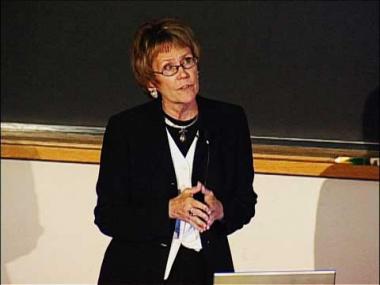 The pace of global carbon emissions may be such that humanity’s best efforts to stabilize them below current levels by 2050 won’t be enough to prevent a significant increase in Earth’s temperatures. Margaret Leinen, drawing on the U.N.’s recent climate reports, and the latest research from the field, shows the dire graph: a red line of CO2 emissions marching steadily upward, with accompanying graphics depicting hoped-for impacts of international efforts to mitigate greenhouse gas release.
The current global abatement “wedges” consist of technologies not yet developed or widely deployed, such as energy efficiencies, cellulosic biofuels, solar, wind, and nuclear. Leinen notes that most of the abatement in renewables “comes into play 20-30 years out,” and the “reality is there will be increases in CO2 in the atmosphere for the next 20-30 years while we try to address the problem.” Policy makers have not begun to grapple with the notion of delayed onset of emissions, says Leinen. Among scientists, there’s growing concern that “we’re going to be dealing with catch-up for a long enough time that we will suffer the consequences of emissions regardless of whether we put
The pace of global carbon emissions may be such that humanity’s best efforts to stabilize them below current levels by 2050 won’t be enough to prevent a significant increase in Earth’s temperatures. Margaret Leinen, drawing on the U.N.’s recent climate reports, and the latest research from the field, shows the dire graph: a red line of CO2 emissions marching steadily upward, with accompanying graphics depicting hoped-for impacts of international efforts to mitigate greenhouse gas release.The current global abatement “wedges” consist of technologies not yet developed or widely deployed, such as energy efficiencies, cellulosic biofuels, solar, wind, and nuclear. Leinen notes that most of the abatement in renewables “comes into play 20-30 years out,” and the “reality is there will be increases in CO2 in the atmosphere for the next 20-30 years while we try to address the problem.” Policy makers have not begun to grapple with the notion of delayed onset of emissions, says Leinen. Among scientists, there’s growing concern that “we’re going to be dealing with catch-up for a long enough time that we will suffer the consequences of emissions regardless of whether we put
MIT World: Engineering >>
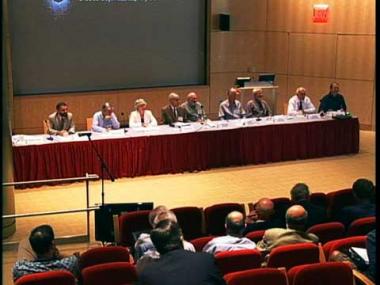 These nine panelists describe ways in which the Second Law of Thermodynamics can be stretched, or applied in less traditional ways.
Adrian Bejan has constructed a law that “covers every configuration in physics, from animate, to inanimate, to us, the societal." Bejan demonstrates how his law describes and predicts the tree-shaped flow of all rivers, animal locomotion and human settlement distribution. With it, says Bejan, “thermodynamics becomes a science of systems with configuration…”
These nine panelists describe ways in which the Second Law of Thermodynamics can be stretched, or applied in less traditional ways.
Adrian Bejan has constructed a law that “covers every configuration in physics, from animate, to inanimate, to us, the societal." Bejan demonstrates how his law describes and predicts the tree-shaped flow of all rivers, animal locomotion and human settlement distribution. With it, says Bejan, “thermodynamics becomes a science of systems with configuration…”
Bjarne Andresen acknowledges “many fights about the Second Law,” before declaring his belief that “entropy survives as a concept, and applies equally in the chemistry lab, to the quantum computer and to black holes.” He discusses the importance of carefully defining the system under examination beforehand, “otherwise you get into fights with your neighbors."
Miguel Rubi discusses how to use the Second Law to extract information about the evolution of small systems. Unlike “canonical thermodynamics,” which describe systems in terms of energy, volume and mass, mesoscopic thermodynamics focuses on systems in terms of positions and movement of particles. Some examples of processes explicable by this kind of thermodynamics include the translocation of ions, RNA unfolding under tension,
These nine panelists describe ways in which the Second Law of Thermodynamics can be stretched, or applied in less traditional ways.
Adrian Bejan has constructed a law that “covers every configuration in physics, from animate, to inanimate, to us, the societal." Bejan demonstrates how his law describes and predicts the tree-shaped flow of all rivers, animal locomotion and human settlement distribution. With it, says Bejan, “thermodynamics becomes a science of systems with configuration…”Bjarne Andresen acknowledges “many fights about the Second Law,” before declaring his belief that “entropy survives as a concept, and applies equally in the chemistry lab, to the quantum computer and to black holes.” He discusses the importance of carefully defining the system under examination beforehand, “otherwise you get into fights with your neighbors."
Miguel Rubi discusses how to use the Second Law to extract information about the evolution of small systems. Unlike “canonical thermodynamics,” which describe systems in terms of energy, volume and mass, mesoscopic thermodynamics focuses on systems in terms of positions and movement of particles. Some examples of processes explicable by this kind of thermodynamics include the translocation of ions, RNA unfolding under tension,
MIT World: Engineering >>
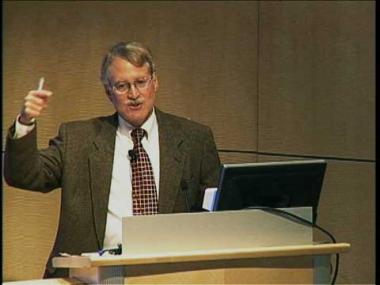 “Biology is messy,” says Kenneth Dill, and it’s “heavily about entropy.” Just look at how biological systems repeat entropy at every possible turn: a parent cell making two daughter cells, sending one DNA molecule to each; and the process of biochemical reactions, with water getting stripped off the molecules. Dill is convinced that the “language of biology in the future will be nonequilibrium statistical mechanics.” He’s engaged in experiments that explore how dynamical laws apply to very small biological systems, such as those inside cells.
Traditional macro-scale dynamics, explains Dill, have laws where concentration gradients or temperature gradients drive flux. But inside cells, there are elements that sometimes contain five molecules, and then in the next instant, 500 molecules. The question is how to think about these highly fluctuating quantities in terms of dynamics. To that end, researchers have been devising experiments to describe the dynamics of micro systems.
Dill’s colleagues have built a microfluidics apparatus that plots the diffusion of microscopic particles over time, their probable routes and rates. To help frame this work, and make predictions about comparable systems, they use an analogy to
“Biology is messy,” says Kenneth Dill, and it’s “heavily about entropy.” Just look at how biological systems repeat entropy at every possible turn: a parent cell making two daughter cells, sending one DNA molecule to each; and the process of biochemical reactions, with water getting stripped off the molecules. Dill is convinced that the “language of biology in the future will be nonequilibrium statistical mechanics.” He’s engaged in experiments that explore how dynamical laws apply to very small biological systems, such as those inside cells. Traditional macro-scale dynamics, explains Dill, have laws where concentration gradients or temperature gradients drive flux. But inside cells, there are elements that sometimes contain five molecules, and then in the next instant, 500 molecules. The question is how to think about these highly fluctuating quantities in terms of dynamics. To that end, researchers have been devising experiments to describe the dynamics of micro systems.
Dill’s colleagues have built a microfluidics apparatus that plots the diffusion of microscopic particles over time, their probable routes and rates. To help frame this work, and make predictions about comparable systems, they use an analogy to
MIT World: Engineering >>
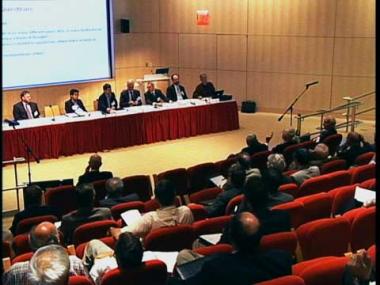 Robert Silbey is an old hand at teaching chemistry (40 years and counting), yet each time he turns to the Second Law of Thermodynamics, he’s “always very nervous.” From this panel of educators, we get a sense of how challenging a classroom subject the Second Law can be.
Joseph Smith notes that the teaching approach “depends on the application,” and applications are both theoretical and practical. Students must first ask what is entropy, and why is it needed, says Smith. He focuses on “idealizations that often get ignored,” such as isolation, equilibrium and system boundaries. “If we don’t get those straight in the beginning student’s mind, then there’s a lot of confusion.”
To Howard Butler’s way of thinking, “teaching the Second Law is much more difficult and challenging a task than teaching Newton’s Second Law of Motion,” both because the concepts involved are so much more complex and abstract, and because the Second Law takes on very different forms depending on which thermodynamic domain is being considered.”
Andrew Foley “tries not to worry too much about what entropy is.” Instead, he handles the whole concept as if it
Robert Silbey is an old hand at teaching chemistry (40 years and counting), yet each time he turns to the Second Law of Thermodynamics, he’s “always very nervous.” From this panel of educators, we get a sense of how challenging a classroom subject the Second Law can be. Joseph Smith notes that the teaching approach “depends on the application,” and applications are both theoretical and practical. Students must first ask what is entropy, and why is it needed, says Smith. He focuses on “idealizations that often get ignored,” such as isolation, equilibrium and system boundaries. “If we don’t get those straight in the beginning student’s mind, then there’s a lot of confusion.”
To Howard Butler’s way of thinking, “teaching the Second Law is much more difficult and challenging a task than teaching Newton’s Second Law of Motion,” both because the concepts involved are so much more complex and abstract, and because the Second Law takes on very different forms depending on which thermodynamic domain is being considered.”
Andrew Foley “tries not to worry too much about what entropy is.” Instead, he handles the whole concept as if it