
Engineering TV >>
 What do a mermaid, a robot and a luchador have in common? They are among the whimsical cast of characters vying for the prestigious position as the spokesperson for global electronics distributor TTI. Tune in here to find out more about how TTI created this unique and innovative ad campaign. Watch the videos and participate in the fun by going to The Big Job.
What do a mermaid, a robot and a luchador have in common? They are among the whimsical cast of characters vying for the prestigious position as the spokesperson for global electronics distributor TTI. Tune in here to find out more about how TTI created this unique and innovative ad campaign. Watch the videos and participate in the fun by going to The Big Job.
Hosted by: Bill Baumann Videography by: Curtis Ellzey Edited by: Curtis Ellzey


 To keep up with demand, the oil industry ventures increasingly farther and deeper offshore, extracting resources as fast as possible in often hazardous conditions with newly minted technology. So to these panelists, the BP Deepwater Horizon accident did not come as a complete surprise. However, they view the disaster from distinctly different perspectives.
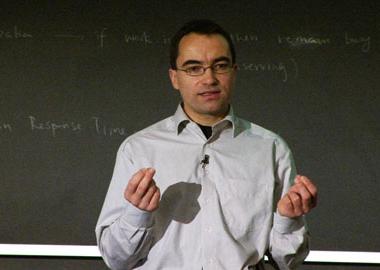 It is well know that we cannot engineer our way out of traffic congestion by building new roads. In fact, expanding the road network may paradoxically attract new traffic, and increase gridlock. Andreas Schulz provides a mathematical explanation for this conundrum. Using Nash equilibria and related game-theoretic concepts he explores two issues, namely: “how much fuel and time can we save if we route traffic optimally, and secondly, can we save fuel and time by actually closing streets or rearranging vehicle flow on our existing road network?” The answers to these questions have significant value. It is calculated by the Texas Transportation Institute (TTI) the cost of congestion, in fuel and time losses, is $87 billion annually (in 2007 dollars). Schulz uses the TTI estimate as a launching point, to ask how much we could save if we routed more optimally.
  Today, cell phones are a menace to safe driving, as they distract operators who should otherwise focus on the road. Tomorrow, cell phones could actually improve our driving, and help drivers avoid traffic congestion, use the road system more effectively, and manage the parking supply. Li-Shiuan Peh says that the key to these services are future mobile devices that will have the computer power equivalent to today’s large servers in data centers. Combined with rapid advances in wireless networking, these mobile devices will be harnessed to provide new apps, like next generation transportation programs.
  It is well know that we cannot engineer our way out of traffic congestion by building new roads. In fact, expanding the road network may paradoxically attract new traffic, and increase gridlock. Andreas Schulz provides a mathematical explanation for this conundrum. Using Nash equilibria and related game-theoretic concepts he explores two issues, namely: “how much fuel and time can we save if we route traffic optimally, and secondly, can we save fuel and time by actually closing streets or rearranging vehicle flow on our existing road network?” The answers to these questions have significant value. It is calculated by the Texas Transportation Institute (TTI) the cost of congestion, in fuel and time losses, is $87 billion annually (in 2007 dollars). Schulz uses the TTI estimate as a launching point, to ask how much we could save if we routed more optimally.
  If you had half a million dollars, would you opt for a passenger car that could drive itself (called an autonomous vehicle) or would you choose a new Ferrari? Emilio Frazzoli provides a number of reasons why autonomous vehicles might be the preferred choice, if not the typical one. Autonomous vehicles, that use electronics in place of human drivers, will offer many improvements for urban mobility. Frazzoli says they will advance the safety and comfort of automotives- and open the doors of mobility for people who cannot or should not drive; as he puts it, “if you had too much to drink, maybe you should let the computer take you home.” Future autonomous vehicles can also increase the efficiency and throughput of our existing road system and help reduce congestion by coordinating with others cars. The autonomous vehicle will also be a “green vehicle” that can make more fuel-efficient decisions than human drivers. Future autonomous vehicles might save up to 20 to 50% of emissions and fuel consumption by optimizing speed and stopping.