
TRaC RSS Feed >>
Latest news from TRaC.
Latest news from TRaC.
TRaC one of the first to offer new VDSL2 testing following new Broadband Forum standards
TRaC - testing consultancy of choice for major telecoms operators around the world - is today (10 December 2009) set to become one of the first laboratories in the world to offer testing against new standards announced yesterday by the Broadband Forum.
TRaC will be utilising its newly extended Hull, UK-based test laboratory to offer its global customer base testing against the new Broadband Forum Technical Reports (TRs) TR-114 and TR-115.
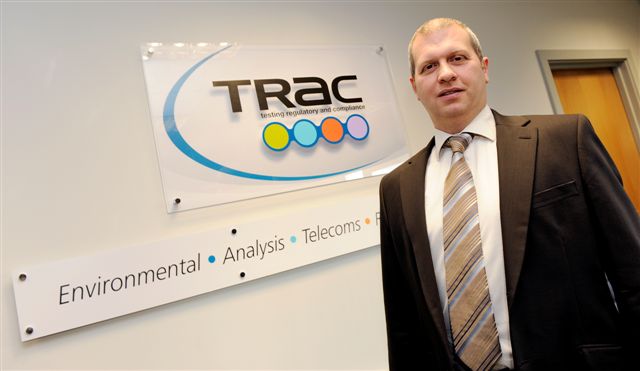 "We have been offering VDSL2 testing for two years but without specific industry-defined standards. Now we have new Broadband Forum recommendations which allow our customers to test their products against a recognised benchmark, in order that they can respond to operator RFPs anywhere in the world where VDSL2 is deployed," said TRaC Telecoms & Radio
 Which ever certification mark you are applying, whether it is the MET mark, UL, CSA or another, if the approval covers Canada, you will have to make some changes. A new ruling by the Standards Council of Canada has required that the type of certification is clearly indicated on the mark (label) used to indicate certification. This can be achieved by either indicating the actual standard to which the product has shown compliance or using the following terms "Electrical Safety" or
 IECEx is an internationally-recognised Conformity Assessment System that runs under the auspices of the IEC; it deals with equipment that operates in any environment where there is a risk of explosion due to the materials used within it. Under a designation accepted in, currently, 31 countries, all such locations are known as Ex Areas, and products tested and found to be safe for use in those areas, as Ex Equipment. Using an electronic certification scheme, equipment that has passed all the required tests is listed on a single database, and is accepted as the basis for national approval in any of
 Through stress analysis, OEMs are able to refine existing products and develop new products that are more robust, reliable and ultimately competitive, in an accelerated timeframe. "FEA is now an important part of product development, necessary to maintain overall competitiveness," said Andrews. "Engineers face ever shortening time to market and product lifecycles, whilst the demand for innovation increases. TRaC provides a service which ensures your products meet your performance goals; handling weight reduction, fatigue, stress and overall product performance issues, so your engineering teams can focus on innovation."
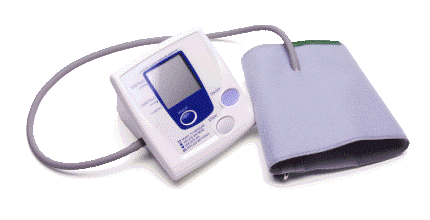 The new accreditation allows TRaC to test and issue IECEE CB Scheme Test Certificates to conduct IEC 61010-2-101 (Particular requirements for IVD medical equipment) and IEC 61010-2-081 (Particular requirements for automatic and semi-automatic laboratory equipment for analysis and other purposes). These standards are heavily used within the IVD equipment arena and have some particular requirements for risk management and risk assessment as called up by ISO 14971.
 TRaC has extensive experience in conformance testing, to a broad range of standards and directives, for commercial, industrial and medical equipment: and of testing military systems to the standards prevalent in that sector. The company was therefore ideally equipped to respond to a request to contribute to the new, definitive Guide to CE Marking Military Equipment. The Guide is currently at an advanced stage of preparation and a draft will be available in time for Defence Equipment and Support’s DVD 2010 event at Millbrook, Bedfordshire, UK, June 23 – 24, where
 The ZigBee Telecoms Service Profile sets out a global standard for wireless sensor networks, which will supply consumer devices with information, location-based services, entertainment content, payment and billing services, and data-exchange services. It will enable consumer devices with an almost limitless