News

Supersonic water jets boost highway improvement project

The destructive power of water is playing a key role in a highway improvement project along one of the busiest roads in the UK’s West Midland region.

Jets of water travelling at supersonic speeds are blasting concrete from around bearings in two flyovers on the A4440 Southern Link Road near Worcester.

The jets are so powerful they can tear lumps of concrete bigger than a fist from around the bearings, exposing the steel rebar for the first time since the carriageway was built.

However, in the hands of the experienced operatives from hydrodemolition specialist Aquaforce Concrete Services, they can also be directed with impressive precision to remove just the right amount material.

Controller for multiple isolation systems EXKOP Express – Self-monitoring safety electronics

In the event of an explosion, the EXKOP Express controller receives a trigger signal, for example from the signalling unit of a flameless venting device, an explosion vent, a pressure detector or an IR-Flame sensor. The EXKOP Express controller then activates the connected explosion isolation systems, causing adjacent plant components to be isolated within milliseconds and protected against explosion propagation. The EXKOP Express is suitable for the following isolation systems: REMBE quench valves QV II and QV III, the Q-Bic extinguishing barrier and the RSV Slide Valve and REDEX Slide.

Together with the REMBE iQ Safety Cockpit, a software program to centrally display the explosion safety of your plant, the EXKOP Express offers the complete monitoring of plant components, process sections and statuses of various protective components. As soon as the EXKOP Express receives a trigger signal in the event of an explosion, it passes this information on to the REMBE iQ Safety Cockpit. Due to the direct notification to the desired communication medium, e.g. the mobile phone of the person in charge, REMBE has enabled causes to be identified in an optimised and targeted manner, thus allowing downtimes to be reduced.

By detecting operationally relevant components for explosion protection or temperature/fire gas detectors and grounding systems for explosion prevention, they can be registered via the REMBE iQ Safety Cockpit and connected to material management. So if a disruptive event such as an explosion occurs, the system detects which areas are affected and provides information about which spare parts are needed to restore the plant to a safe condition as quickly as possible. These functions can be presented in the operator’s system as a “suggestion” or can be sent directly to the manufacturer as a non-binding request. Continuous optimisation of processes is made possible through detailed documentation and evaluation of all results.

www.rembe.de


Howden secures contract to supply a mine cooling system for OZ Minerals, Australia

Leading global provider of mission critical air and gas handling products, technologies and services, Howden, has won a contract to supply a cooling system for the expansion of the Prominent Hill mine in South Australia for OZ Minerals. 

The solution provided by Howden will be for the complete mine cooling system and Howden’s equipment will ensure safe productive outcomes at depth and will bring additional efficiencies to reduce environmental impact for current and future carbon footprint compliance.

Howden will focus on sustainability and the solution will include closed circuitry on both condenser and evaporator circuits and R717 (Ammonia) compressors which emit no harmful CO2 or HFCs.  The system consumes no water, using the ambient air as the cooling medium and Howden will supply chillers, air cooled condensers, bulk air coolers, pumps, electronic controls and hydraulic design.

Camille Levy, President of Howden APAC, comments: “Howden works in partnership with customers to create solutions for their needs which are of the highest functionality, while supporting their net zero targets. This project is no exception. Our unique combination of manufacturing excellence, technical and project deliverables, and our global experience, also contributes to the reduction of carbon impact of operations.”

The use of Howden refrigeration screw compressor technology coupled with first class OEM suppliers of condenser coolers and bulk air coolers were other supporting factors in the successful offer which will be delivered by the Howden team in China.

Howden focuses on helping customers increase the efficiency and effectiveness of their air and gas handling processes enabling them to make sustainable improvements in their environmental impact.  Howden designs, manufactures and supplies products, solutions and services to customers around the world across highly diversified end-markets and geographies.

The business recently announced its target to be carbon Net Zero by 2035 through the purchase of renewable energy and carbon free energy; efficiency gains from energy conservation measures; and by renewable energy projects at its manufacturing facilities. The largest impact the business will have on global sustainability will be through its partnership with customers to supply equipment that will make a major impact on their carbon emissions and sustainability.

www.howden.com 

A NEW DESIGN FOR VALPES ATEX ELECTRIC ACTUATORS

Valpes’ range of ATEX electric actuators has evolved with a new design and dimensions!

Valpes took the opportunity offered by compliance with the latest requirements of the ATEX directive (2014/34/EU) for installation in potentially explosive and hazardous atmospheres.

New certifications are also achievable for new markets with EACEx (Russia) and IECEx (international) certification.

Valpes is Zoedale’s  electric actuator supplier. It’s a worldwide brand, offering a wide range of electric actuators including quarter-turn, multi-turn and part-turn.

Let’s look at Valpes’ existing range of ATEX electric actuators, plus the added features and dimensions of the new design.

ATEX electric actuators

An electric actuator allows a valve to be adjusted remotely, or large valves to be operated rapidly. They play a major part in automating process control. 

ATEX-rated electric actuators are suitable for any potentially explosive or hazardous environment and any application requiring aluminium housing.

Application examples include technical building, construction equipment, valve control, damper control and in the gas and oil industries.

Valpes’ existing ATEX VR, VS, VRX and VSX electric actuators

So, what does the original range consist of?

The VRX and VSX are both IP68 rated, ATEX certified quarter-turn electric actuators with aluminium housing and cover.

The VS is an IP68 rated, failsafe, quarter-turn electric actuator with aluminium housing and polyamide (meets UL94V0 standards) or aluminium cover.

The VR is also an IP68 rated, quarter-turn electric actuator with aluminium or polyamide housing.

Both the VS and VR include a Bluetooth communication module.


New design


Valpes have taken the opportunity to redesign the casings of the VR, VS, VRX and VSX  electric actuator ranges.


This new design has the following features:


Enlarged identification plates


The new design incorporates an area for a new, more detailed and more legible identification plate, and the number of markings have also increased.

New dimensions           


•               11mm extension of VR and VRX housings

•               15mm extension of VS and VSX housings

The dimensions of the covers remain the same.

Expanded certifications


Valpes’ ATEX electric actuators are compliant with the latest requirements of the ATEX directive (2014/34/EU) for installation in potentially explosive and hazardous atmospheres.

They also meet the certification requirements for new markets: EACEx (Russia) and IECEx (international).


Valpes new design will also be used for the LT range (low temperature actuators) and the DV range (DNV-GL certified actuators). More details to come soon.

Does this new design interest you? Please email  This email address is being protected from spambots. You need JavaScript enabled to view it. or call us on 01234 832 832 to discuss how it might fit your requirements.

Clink the link below for more information .


ANTI-SLIP COATINGS OUTLAST AND OUTPERFORM SAND-IN-PAINT SYSTEMS AND TAPES

Workforce injuries resulting from slips and falls are one of the leading, longstanding causes of unplanned workplace absence.  The latest statistics from the Health and Safety Executive (HSE) make for a sobering read. https://www.hse.gov.uk/statistics/causinj/index.htm

Of the annual 750,000+ non-fatal injury reports it received in the UK, 29% cited slips, trips and falls, on the same surface level, as the cause.  And this translated into a phenomenal 11.25 million lost working days in just one year. 

So, the application of anti-slip coatings to all risk areas not only makes sound sense from a health and safety perspective but also from an operational and cost efficiency standpoint too.  Coatings are available with a broad range of characteristics that don’t just create a durable anti-slip finish for people but vehicles as well, ranging from light to heavy traffic.

LOCTITE® is a brand with notable benefits in this field.  Products in the range outlast and outperform typical sand-in-paint systems and tapes and are proven to be the strongest, most aggressive anti-slip methods available.   Typical applications include ramps, walkways, stairs, changing rooms, machine shops, assembly areas, warehouse floors and loading docks. And they are suitable for use on concrete, asphalt, wood, ceramic, fibreglass and metal surfaces with applications across industry, commerce and in the public service, utilities and transport sectors. 

Rhodri Morgan Ex-Protection UK Technical Lead at TÜV SÜD, a global product testing and certification organisation.

UKEX – Practical Consideration and Implementation

UKCA marking (UK Conformity Assessed marking) is the UK product marking requirement that will be needed for all Ex-products being placed on the market in Great Britain (England, Scotland and Wales). This substitutes the European Union (EU) requirements for CE Marking, which continues to be accepted in Northern Ireland.

UKCA Ex (UKEX) approval came into force from 1st January 2021, with a transitional period lasting up until 1st January 2023. However, the UKCA mark will not be recognised in the EU, European Economic Area, or Northern Ireland. For Northern Ireland, either the CE mark or dual UKNI and CE mark may be required.

To allow businesses time to adjust to the new requirements, CE marked ‘existing stock’ can still be accepted up until 1st January 2023. For example, if machinery was fully manufactured and ready to be place on the market before 1 January 2023. With respect to existing products, the rules for the EU and UK are the same, the legislation applies at the point when the individual product is placed on the market. This means that UKCA marking would not be required for products already placed on the market, for example, items which are already imported and sitting with a distributor which was prior to 1st Jan 2023.

Fusion boffins get new shield against COVID contamination

Hundreds of scientists and engineers working on the UK’s race to harness fusion energy are being protected from COVID-19 contamination by new super-tough anti-microbial coating Touchpoint Shield.

The UK Atomic Energy Authority (UKAEA) has commissioned bio-hazard cleaning and decontamination specialist SafeGroup to install Touchpoint Shield in washrooms and toilet areas.

Facilities managers at the authority’s research centre near Abingdon, Oxfordshire, were impressed with trials that proved the coating suppressed the build-up of SARS-Cov-2, the COVID-19 virus.

A team of SafeGroup technicians has now applied the fast-drying and nearly invisible Touchpoint Shield to showers, toilets and taps at multiple locations across the 200-acre fusion energy research site.

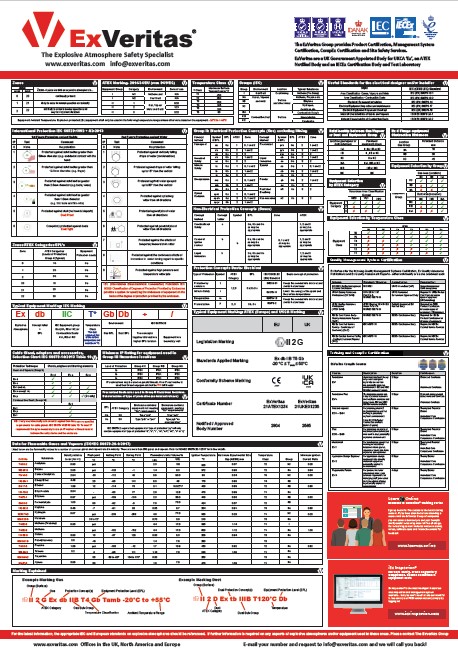
When can a Zone 1 rated product be safer than a Zone 0 rated product?

This scenario seems impossible, but it is a real-life or death possibility. This is because Zone ratings are measured independently from temperature codes and gas group types defined within the ATEX and IECEx classifications.

Zone 0 is defined as an area where an explosive atmosphere is always present. Zone 1 is defined as an area in which an explosive atmosphere is likely to occur during regular operations due to scheduled maintenance, accidents, or leakage.

Temperature codes refer to the maximum surface temperature of any device component that can be exposed to a hazardous environment in a fault condition. A T1 rating can be up to 450°C (842° F), but a T4 rating cannot exceed 135°C (275° F). These significant differences between temperature codes often go unnoticed unless examined closely.

Likewise, gas group ratings require careful scrutiny. Group B type gas contains explosive gases like Hydrogen and Etheylene Oxide, while Group D type gas contains less volatile gases like Propane and Gasoline vapors. These differences often go unnoticed by safety professionals who rely solely on a Zone rating for guidance.

These T codes and gas ratings can confuse someone into believing a Zone 0 device with a T1 code, and a rating for group D type gases is safe for use in a Zone 1 environment that requires a T4 code and a rating for group B type gases. In this specific instance, the Zone 1 product rated for this environment is safer than the Zone 0 rated product.

All equipment safety ratings must be based on the potentially hazardous environment it may encounter as the current one may quickly change without you being aware of it. If you are unsure, analyze the work environment, determine the worst-case scenario, and equip your teams accordingly.

Nightstick, a global manufacturer of intrinsically safe, professional, portable LED lighting products that exceed industry standards in performance, quality, and user safety, has over fifty intrinsically safe products. You need to focus on completing your job with confidence, know­ing your equipment was designed and rated for the highest levels of safety when your life depends on light.

Find the certification level you need at www.nightstick.com

McMenon eyes further growth in nuclear and renewables with senior appointment

ENGINEERING specialists McMenon have made a senior appointment as the UK company further expands in the nuclear and renewables markets.

Scott Castlehow has joined McMenon as its new Business Director to help the Workington-based firm achieve further growth in nuclear, renewables, defence and other sectors.

Scott brings to McMenon almost 20 years of experience in a range of industries, including nine years in the nuclear and decommissioning sector, and ten years in the aeronautical industry.

McMenon CEO Anand Puthran said: “We are delighted Scott has joined McMenon at such an exciting time in the company’s development as we expand in the nuclear and renewables markets.

“The timing is perfect to enable our plans to become one of the main Cumbrian SME suppliers to the nuclear industry. McMenon, along with TIS Cumbria, has formed the North West Energy Coast Alliance, to compete for, and deliver, large projects in the nuclear sector.

“Scott’s invaluable experience in this sector will aid us as we look to continue our growth across all markets.”

Scott said: “I will be helping McMenon develop its engineering and manufacturing solutions within new sectors. It’s a great opportunity and I am really looking forward to it.

“I am inspired by the CEO’s passion, and I will feed off Anand’s drive and his vision. McMenon is a key player in the delivery of flow and temperature instrumentation products within the global energy industry. But there are lots of opportunities through engineering and manufacturing to grow McMenon’s offerings in the nuclear, renewables, defence and other sectors.”

Scott will manage McMenon’s technical engineering and supply chain departments and lead business growth in the nuclear, renewables and defence sectors.

McMenon has built a global reputation for design and manufacture of quality, specialist flow and temperature measurement products supplying to more than 50 countries around the world. It also provides complete contract engineering and manufacturing solutions, and fabrication, pipework and welding services.

DSEAR 3 DAY COURSE - Risk Assessment Training

Our “Three Day” DSEAR course is aimed at those who responsible for conducting DSEAR assessments, but are not necessarily fully confident with the process. They may work in a flammable environment, in-addition to being responsible for managing the area, day to day.

The course content:

  • Legal foundations
  • How sources of danger arise.
  • What is the difference between flashpoint, fire point, boiling point and Auto Ignition?
  • The fundamentals on the origin of Explosions, Deflagrations and Fires
  • Risks resulting from improper storage or handling of these substances
  • The meaning of the danger triangle and pentagon.

An overview of the regulations, understanding solvents and their physical properties, explosive dusts, ATEX classifications, gas groups, temperature ratings and BS 60079-10 Ex Zone determination, all giving a greater understanding of how ATEX fits into the DSEAR equation when establishing hazardous zones.

Reference is made to the theoretical understanding of flammable vapours with examples of how the L.E.L can be converted into a meaningful quantity of chemical per cubic metre.


Supported by a full and detailed 200-page, training manual to assist with their learning.

Our “Three Day” DSEAR training course is aimed at those who may be responsible for conducting risk assessments, but are not necessarily fully confident to do so with such a technical subject.


The Course Content :

Legal foundations of DSEAR and COSHH

How Fires and explosions occur,

The fundamentals of understanding the explosive potential - Deflagrations

Understanding the Chemical Properties of a substance

Risks resulting from improper storage or handling of substances

The danger triangle and dust pentagon.

Dust explosion potentials

An overview of the regulations is included along with, explanations and understanding of solvents and their physical properties, explosive dusts, ATEX classifications and coding, gas groups, temperature ratings and BS 60079-10 Ex Zone determination, all giving a greater understanding of how ATEX fits into the DSEAR equation when establishing hazardous zones.

Reference is also drawn to the theoretical understanding of flammable vapours with examples of how the Lower Explosive Limit can be converted into a meaningful quantity or volume of chemical per cubic metre of space.

The course includes:

A detailed 200-page, training manual for all delegates

Working group activities

A “multiple choice” exam

Buffet Lunch Tea Coffee and refreshments. – COVID conditions apply.

Venue and Dates 2022:

Cannock Staffordshire

March 15-17th

Jun 14-16th

Oct 11-14th.

www.dsc-ltd.co.uk

This email address is being protected from spambots. You need JavaScript enabled to view it.

01952 947682

07989 597569