
Analog Devices' Marcus O'Sullivan demonstrates the ADM1275, a power-management chip for blade servers. The device integrates a hot-swap controller with a PMBus power monitor. The hot-swap circuit uses advanced techniques to monitor sense-resistor current very accurately, at very low loss, allowing the use of smaller-value, lower-loss resistors. While the PMBus power monitor reports power usage with very high accuracy, along with energy metering and fault monitoring.
Hosted by: Don Tuite Videography by: Curtis Ellzey Edited by: Curtis Ellzey
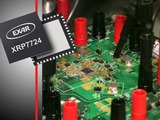
Exar showcases the the next generation in its PowerXR family of programmable power system ICs at APEC 2011. The four-channel IC, XRP7724, features expanded voltage and current ranges, SMBus compliant I�C interface, and independently controlled channel frequencies.
Hosted by: Don Tuite Videography by: Curtis Ellzey Edited by: Curtis Ellzey
From Texas Instruments (TI) the TAS5706 is a 20-W, efficient, digital audio power amplifier for driving stereo bridged-tied speakers. Two serial data inputs allow processing of up to four discrete audio channels and seamless integration to most digital audio processors and MPEG decoders, accepting a wide range of input data and clock rates. A fully programmable data path allows these channels to be routed to the internal speaker drivers or output via the subwoofer or headphone PWM outputs. The TAS5706 is a slave-only device receiving all clocks from external sources. The TAS5706 operates at a 384-kHz switching rate for 32-, 48-, 96-, and 192-kHz data, and at a 352.8 kHz switching rate for 44.1-, 88.2-, and 176.4-kHz data. The 8x over sampling combined with the fourth-order noise shaper provides a flat noise floor and excellent dynamic range from 20 Hz to 20 kHz.
The TAS5162 is a high performance, integrated stereo digital amplifier power stage with an improved protection system. The TAS5162 is capable of driving a 6- bridge-tied load (BTL) at up to 210 W per channel at THD = 10%, low integrated noise at the output, low THD+N performance without clipping, and low idle power dissipation.
As wireless data rates move toward the future with even faster 4G services, the ability to efficiently handle the large number of bits flowing through base stations becomes critically important. Operators are being forced to move to heterogeneous networks that combine macro and small cell solutions to deliver affordable bandwidth. TI�s TCI6618, a new multistandard wireless base station system-on-chip, delivers double the LTE performance over existing 40-nm solutions, and is ideally suited to the data-centric performance that operators are demanding today for 4G macro base stations.