
News
Water power helps drive a wind energy revolution
Ultra-high pressure water jetting is proving its importance in keeping the development of the UK’s critical off-shore wind farm development programme on track.
Offshore wind farms are now vital to meeting the UK’s electrical energy requirements for the rest of the 21st Century and beyond. New turbine farms are being installed at a rapid rate.
Meanwhile, the first farms, installed two decades ago, are already reaching the end of their lives and are being decommissioned, creating new and demanding demolition challenges.
Ultra-high water pressure (UHP) jetting specialist RGL, a member of the Water Jetting Association, is developing technology that enables power companies and demolition contractors to overcome these challenges safely and sustainably.
Once the above-sea-level turbines have been lifted away, what is left is a steel or concrete monopile that has been driven into the sea bed many metres below sea level.
Jeremy Twigg, Commercial Director of RGL, based in Romsey, Hampshire, said: “Removing these monopoles is the big challenge, not least because of the over-riding need to do it safely.
“In most cases, they have to be cut below the sea bed to ensure they don’t pose a risk to or can snag on fishing nets. In many cases, they must also be removed without the use of divers.
“We’ve a range of bespoke ultra-high pressure water jet cutting tools that allow us to cut these monopiles remotely no matter how big they are or what the depth of water.”
WJA Director David Kennedy said: “This is a great example of the growing importance of water jetting across many industrial sectors, as delivered by WJA members in the UK and internationally. The technology is proving safer, more productive and more sustainable than other solutions.”
An example of the work carried out by RGL has been a project to remove two monopiles from the Blyth Offshore Wind Farm, sited a mile off the coast of Northumberland.
It became the first wind farm to be built in UK waters, developed by a consortium comprising of E.ON UK Renewables, Shell Renewables, Nuon UK and AMEC Wind.
After 18 years of service, two of the wind turbines had reached the end of their lives and it was decided they were to be decommissioned.
E.ON appointed marine contractor Fugro Geoservices Ltd to carry out the demolition work. In turn, Fugro Geoservices appointed RGL to undertake the subsea cutting.
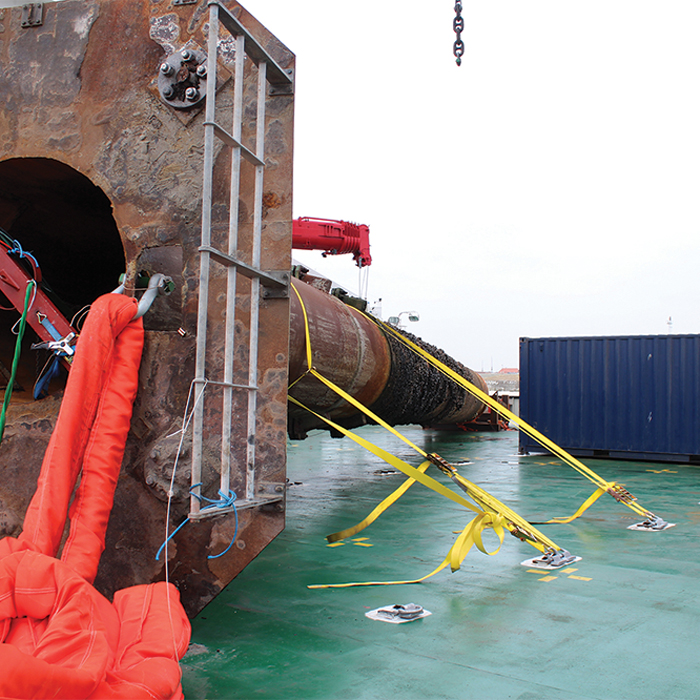
RGL manufactured a bespoke robotic abrasive water jetting tool to cut through the 50mm thick steel walls of the 3.4m diameter monopiles and 200mm of 200mm cementitious grout annulus.
Working from an offshore jack-up maintenance barge, after initial water jet cutting to prepare the monopile, the cutting tool was lowered inside the giant steel tube to the specified one metre below the sea bed, then fixed into position with hydraulic arms.
The rig has two jetting heads to accelerate the cutting process. The combination of potable water jets, operating at 2,800bar (40,600psi) and an abrasive additive of garnet chips, easily cut through the grout and the steel pile in less than 12 hours.
Ultra-high pressure water jetting and abrasive water jet cutting can be used in different ways to cut and demolish steel, stone and concrete structures.
Jeremy Twigg said: “Hydrodemolition is proving to be the best, and in some cases, the only way to remove monopiles in these challenging environments. We’ve taken down piles where previous attempts using diamond cutting had failed.
“Over the coming decades, there is no doubt hydrodemolition will be crucial to maintenance and development of off-shore wind farms.”
For more information visit:
www.waterjetting.org.uk
www.rglservices.co.uk
