
News
RICHTER PERIPHERAL PUMPS MASTER WAX PRODUCTION
RICHTER PERIPHERAL PUMPS MASTER WAX PRODUCTION
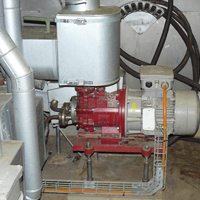
Whilst the properties of Montan wax, also known as lignite wax or OP wax, make it a superb raw material for the manufacture of car and shoe polishes and as a lubricant for moulding paper and plastics, these same properties present unique challenges for engineers who wish to convey the wax within a process.
Clariant Produkte (Deutschland) produces and processes, among other things, synthetic and natural waxes at their Gersthofen site in Bavaria. Read More
Whilst the Synthetic waxes are used in printing inks, paint systems and textiles for coating citrus fruits, the natural montan waxes are mainly for the care product sector as they improve scuff resistance, increase water repellence, and impart high gloss. They are obtained by solvent extraction of certain types of lignite or brown coal, commercially viable deposits of which exist in only a few locations, including Amsdorf, also in Germany.
Franz Kovanetz, Production Engineer at Clariant, explained his process requirements, "Montan wax is recovered from bitumen-containing lignite and processed in several stages to obtain the end product. We have operating conditions here under which some pump designs would fail very quickly!"
"Firstly, we need pumps which can convey a foaming, corrosive medium at a pressure of over 4 bar. Centrifugal pumps frequently fail in this task; if the media starts to foam, conventional centrifugal pumps cavitate, causing damaging vibrations. In addition, as we are dealing with molten wax, the pumps must be heatable to run at temperatures of up to 130°C with heating provided by steam at 145°C. They must also be able to handle varying volumes, from between 300 and 2,000 litres per hour."
"Finally, in the process stage of oxidation, pumps have to convey on the one hand, the oxidant itself, and on the other hand, the oxidation product still contaminated with oxidant. In this step of the process, legislation demands the use of hermetically tight pumps. In the past, all conventional magnetic drive pumps caused problems in this application. That meant shorter service lives due to sedimentation and damage due to cavitation."
These challenging requirements had created severe problems for the plant engineers as he continued, "For a long time there was not one single pump manufacturer who could offer a corrosion-resistant centrifugal pump with this broad range of flow rates - 2000 l/h was not the problem, but rather the low flow rate of 300 l/h. Some manufacturers even declined to offer, given the required pressure of over 4 bar. The centrifugal pumps with mechanical seals available 20 years ago had a service life of between one day and two weeks – a dream for every pump manufacturer, but a nightmare for ourselves!"
Franz Kovanetz and his team finally achieved a service life of around two years using a specially installed mechanical seal to comply with the challenge of statutory demands regarding freedom from leaks. At that time, they also tried out the standard process pumps of the MNK series from Richter Pumps, but even these very robust pumps did not have a satisfactory service life for this application owing to the extreme cavitation.
The breakthrough was only achieved by using Richter's MPB peripheral pumps which are specially tailored to the delivery of low flow rates at high delivery heads - a range not economically covered by standard centrifugal pumps. The pumps are hermetically sealed and have a magnetic power coupling which equates to no seals and virtually maintenance-free operation. Varying volumes can be coped with efficiently by means of frequency control.
Peripheral pumps, also known as regenerative or regenerative turbine pumps, are designed for relatively low capacities which require pumping to high heads. Their impeller has short vanes at the periphery which pass through an annular channel. The fluid enters between two impeller vanes and is set into a circular motion - this adds energy to the fluid particles which travel in a spiral-like path from the inlet to the outlet. Each set of vanes continuously adds energy to the fluid particles.
Peripheral pumps are more efficient at these low flow, high head conditions than centrifugal pumps, they also require much less NPSHA (Net Positive Suction Head Available) than an equivalent centrifugal pump. Of particular importance, they can also handle liquids with up to 20% entrained gases.
The design of a peripheral pump is specially geared to conveying fairly small volumes to very large heads - operating conditions which frame-mounted pumps do not cover economically. The Richter MPB pump is self-priming up to approximately 6m (water @ 20°C), conveys volumes between 0.1 and 5 m³/h and achieves delivery heads of up to 100 m. It covers a temperature range from -60 to 150°C and operates from a vacuum (at standstill) up to 16 bar, depending on the accessories. It is hermetically tight and has a magnetic drive rating of 6 kW at 2900 rpm or 7.2 kW at 3500 rpm on request. Thanks to the choice of materials (PFA/PTFE, SSiC), the MPB peripheral pump virtually has universal corrosion resistance and can handle media with a gas content of up to 30% by volume.
The reduced life cycle costs of the peripheral pumps give Clariant two major advantages as Franz Kovanetz explained, "Firstly, we have a considerably longer service life and the maintenance costs are substantially lower. Given the expected service life of four years, we are assuming a cost advantage of several thousand euros for each pump."
"Secondly, and equally important, is that the plant has to cope with fewer disruptions. Every interruption in a continuous process always means affecting product quality. Even if one continuous plant is run constantly, the product quality remains at a high level without fluctuations. Moreover, all pumps are integrated into the process control system – for example, there is also an automatic routine for cleaning the pump."
The long service life with low maintenance costs is mainly due to the design of the impeller seal - the patented sealing lips integrated in the impeller provide the sealing, which is crucial for high efficiency, between the impeller and the housing wall of the silicon carbide ring channel. The sliding surfaces of the ring channel are polished to a high-gloss finish – which allows the sliding of the impeller sealing lips producing minimum friction and minimum wear.
Another crucial advantage is the simple and quick assembly: the resilient sealing lips dispense with the need for adjustment of the impeller ring channel to an accuracy of 0.1 mm. Such close but hydraulically important gaps frequently result in premature wear in conventional peripheral pumps – especially with fluctuating temperatures – and require a large amount of time for their precise assembly and maintenance. However, the sealing lips of the Richter MPB impeller compensate for the dimensional changes caused by thermal action.
This is particularly important for Clariant: both the oxidant and the oxidation product still containing acid have temperatures of well over 100°C. "The Richter peripheral pump offers very good temperature resistance and it easily withstands even very small temperature shock." commented Franz Kovanetz.
Today, Richter peripheral pumps are the standard at Clariant for conveying highly oxidising substances and other corrosive media. These pumps are proving successful and have the longest service lives thanks to special technical details: An MPB pump installed for test purposes in 2004 is also still running without any problems in 2011.
Richter Pumps are available in the UK exclusively through Billingham-based Tomlinson Hall Ltd who were appointed sole UK distributor earlier this year. The appointment coincided with Tomlinson Hall's success at this year's Pump Industry Awards where the company was named Britain's Pump Distributor of the Year for the second consecutive year.
Renowned for their innovative magnetic drive and mechanically sealed plastic-lined pumps for difficult corrosive and hazardous fluids, Richter pumps have now become the standard within the European chemical, petrochemical and pharmaceutical industries and other sectors where corrosive, hazardous, contaminated, pure and ultrapure media are used.
Colin Simpson, Sales Director at Tomlinson Hall, added, “Richter has set the bar for PFA-lined magnetic drive and mechanically sealed pumps for decades, and we are delighted to have been chosen to help re-establish the brand here. The appointment is also further testament to our own commitment to providing the very best global pump products to industry."
“Richter’s innovative approach to its products, coupled with its reliability, environmental protection and low maintenance requirements has ensured the brand remains an excellent investment for buyers. Their products vastly outperform the competition on a number of operational levels throughout the world, including those produced here in the UK. This year will also see the global launch of their new range of PFA-lined and mechanically sealed pumps so it's exciting times for both organisations.”
Tomlinson Hall is a family owned business based on Teesside specialising in the distribution of pumps, power transmission equipment and engineering supplies. For further information on Richter pumps, please contact Colin Simpson on (01642) 379500 or visit www.richterpumps.co.uk
