

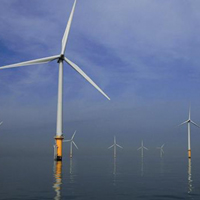
 Manufacturer Gears Up For Record-Breaking Turbine
Offshore wind turbines have been getting bigger and better since the first wind farm was installed in Denmark in 1991. Nowadays, the general rule is the bigger the wind turbine the more energy it can produce, reports Sam Shead.
With this in mind, South Korean company Samsung Heavy Industries (SHI) is developing a 7MW offshore wind turbine that promises to be the most powerful of its kind when it’s demonstrated towards the end of 2012. (Read More) The firm plans to test the new generation of wind turbines at Fife Energy Park off the east coast of Scotland before taking orders to build them at its European facility in Methil, Scotland.
Advertisement - Hover to see more
Advertisement - Hover to see more
Advertisement - Hover to see more
In order to help SHI achieve its goal, David Brown, a company that is perhaps best known for having its initials on the back of several Aston Martin models, will be delivering an innovative new gear system that will be able to generate three to five per cent more energy than existing gearboxes.
This increase in energy output could be key to energy companies that are deciding which gearbox to go with in an age when government is desperately trying to bring down offshore wind’s cost of energy from £150 per megawatt hour to £100 per megawatt hour by 2020.
Ian Farquhar, managing director of wind energy at David Brown, said: ‘We’ve probably got in David Brown the most comprehensive gear-making capability in the world.’
Farquhar explained that David Brown works in an environment where in the design and production of a gearbox, the cost or consequence of failure, in relation to a wind turbine, is extremely high.
But how exactly did David Brown end up in the wind-energy market? Scottish entrepreneur, Jim McCull, bought the 152-year-old Huddersfield-based gears company back from the US after it had a 10-year-spell at Textron. The £368m sale went through in November 2008 and the company is now targeting new and developing markets.
David Brown began assessing the performance of the existing gearboxes in wind turbines and found some alarming statistics.
‘Offshore wind turbines are designed to survive for more than 25 years. But we found that there was a very high rate of interventions related to gearbox issues between six and 10 years,’ said Farquhar.
“Our estimates tell us that the market for gearbox repair was $150m last year. By 2020 that will grow to $2bn” Farquhar went on to establish a business unit of David Brown that specifically looked at post-warranty inspection work, which helped the firm to identify a lot of common gearbox failure issues.
‘We saw that because of the very variable and poorly understood loads that the winds drive into these gearboxes, there are a lot of misalignment effects in the forces going through the gearboxes and therefore a lot of bearing failures and gear tooth failures,’ he explained.
The costs of repetitive gearbox failures are enough to plunge wind-energy companies into spiralling financial difficulties. ‘One manufacturer quoted to me the cost of an insurance claim for one written-off gearbox can be up to $500,000,’ said Farquhar. ‘Our estimates tell us that the global market for gearbox repair was maybe $150m last year. We believe that by 2020 that market will have grown beyond $2bn.’
David Brown spotted the gap in the market for more reliable gearboxes and launched a service and repair business to mend broken gearboxes. This enabled it to gain additional valuable experience on the trends and failure modes of existing equipment, which it used to provide a series of upgrades to existing turbines, for companies such as Vesta, one of the world’s oldest and largest wind-turbine companies.
But as you may have guessed by now, in addition to repairing gearboxes it is also manufacturing customised gearboxes for new customers, such as Samsung Heavy Industries. ‘Having seen all of these different design models, common failure modes, and having an understanding for some of the challenges that exist offshore, we can design a specific application for a customer,’ said Farquhar. ‘We’re very much like the Saville Row of gearboxes in that we will design something specific to the customer.’
Building a gearbox for the world’s most powerful wind turbines Farquhar explained that one of the key criteria for wind turbine gearboxes is that they are as light as possible.
Heavy gearboxes require stronger tower structures and present greater transportation and erection issues. Approximately 20 per cent of the mass of a wind turbine is associated with the gearbox, the largest single contributor after the blades.
The compact, low-weight gearbox that has been designed for SHI will still weigh between 50-90 tonnes but Farquhar claimed it is 10 to 15 per cent lighter than any competitor product on the market.
The gearbox is a multi-stage epicyclic (planetary) unit, which means it has several outer gears revolving about a central or ‘sun’ gear. The planet gears will be mounted onto a movable arm or carrier and provide a link to the outer annulus gear, which will have a diameter of approximately 3m. David Brown claims the system will offer a combination of high power density, efficiency and structural integrity.
“Our motivation is not purely about maximising the selling price. We’re taking a whole-life cost view”
The gearbox will initially cost somewhere between £500,000 and £900,000 but the company hopes to reduce this over time.
Farquhar said: ‘Our motivation is not necessarily purely about maximising the initial selling price. We’re taking a whole-life cost view. The way in which we’re working with our customers means we are all motivated to try and make continuous improvements.’
Samsung has elected and signed a memorandum with Methil and Fife Council to potentially set up a £100m assembly facility in Scotland for 500 people. David Brown has an agreement with Samsung that it will set up an assembly facility in the same location if Samsung goes ahead with this plan.
On a more immediate note, David Brown is planning to expand its Yorkshire facilities in order to meet the demands of the new partnership with SHI.
Two new buildings that are being built in Mirfield will include a gearbox research and innovation centre, as well as a gear-manufacturing centre of excellence.
Farquhar said this one project could increase the current size of the company by three to four times.
David Brown is seeking to draw on its gear history to solve a relatively contemporary issue. The company is looking to make a significant difference to the wind energy market and its new gearboxes could help to reduce the price of wind energy, making this renewable source a far more attractive option.
