
News
FlexIR Electrical Maintenance Safety Device Solutions “Inspect the Uninspectable”
 FlexIR Electrical Maintenance Safety Device Solutions “Inspect the Uninspectable”
The power generation industry has the most rigorous electrical preventative maintenance (EPM) programs in the electrical maintenance industry and knows the cost of losing power to the customers it supports…
Their programs have to be better, more efficient and safer than that of their customers, and their customers demand this. (Read More) There are however some areas within a critical system that leave the power generation extremely vulnerable due to inaccessibility issues, one of these areas is the Isophase Bus, Bus way and bus bar systems.
These systems are the only critical components within the plant that usually have no redundancy and no quick replacement solutions. Electrical Maintenance Safety devices (EMSD’s) such as the FlexIR range of product lines are extremely useful in helping asset owners identify issues before outages, allowing for more efficient outage planning and prioritization of needed repairs.
One of the tasks that need to be completed on electrical equipment whilst it is energized and under load is infrared (IR) scanning…. IR Cameras can only measure what they can see (Direct Line of Sight) and cannot see through glass or plastic viewing windows commonly fitted in switchgear. To allow the inspections to be completed under load we use an IR window which is an EMSD that allows an IR camera to see the energized loaded connections through a special lens material in the IR windows whilst the switchgear remains closed and in a safe and guarded condition thus ensuring that the inspector is never exposed to the dangers of Arc flash or electrocution.
The issue with isophase bus systems is that they do not have covers over each of the joints that can be easily removed, unless the covers are bolted you would need to cut open the bus and inspect/repair the joint and then weld in a new cover, this is an extremely time consuming operation and before embarking on this type of intrusive and very expensive repair you would need to be sure that your diagnosis is correct. Currently isophase bus infrared inspections are completed by looking at the outside of the bus bar, this is known as an indirect inspection (Fig 1).
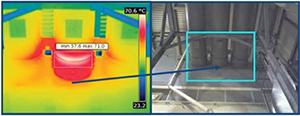
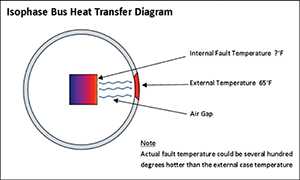
The problem with this type of inspection is that it doesn’t show you what type of fault you have and what the actual fault temperature is at the source of the defect… the internal air gap in the isophase bus acts as an insulator and the heat energy generated by the fault has to travel across the air gap and warm the outer casing of the bus system, which is a large mass of metal that needs to be heated (fig 2), this can also then be hampered by the environment effects of ambient temperature, wind, snow, ice, etc… this type of inspection is extremely difficult and by the time you have seen any type of trace temperature profile on the external surface the damage is probably excessive and beyond repair….
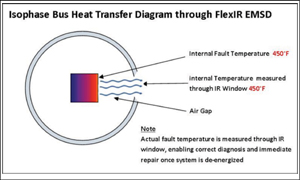
 Inserting a FlexIR EMSD into the isophase bus system opposite the bus joint will enable the inspecting engineer to complete a visual and infrared scan of the bus joint whilst under full load at any time thus ensuring that any faults can be easily identified and assessed for repair (Fig 3). The FlexIR system can also be equipped with onboard temperature measurement to measure the delta (difference) between the ambient and internal temperature and can remotely alarm the support engineer when the temperatures are above a pre-determined level or different from other joint temperatures in the system….
The IRISS FlexIR system for Isophase bus is a large format infrared and visual inspection window that is specifically designed for the power generation and large power user market. The window design also acts as an access port for repairs as it can be easily removed to allow the engineer access to repair the fault. Once refitted the isophase system can be re-energized and the repaired joint can be inspected to check that the repair was effective, thus this unit:
The benefit of using EMSD’s is that they standardize the inspection routes as they become data collection points for the test equipment and also ensure that all the inspection parameters are fixed and all collected data is standardized ensuring that any trend analysis data is accurate.
Other benefits include:
- Maintain Bus in an enclosed and guarded condition
- Remove risk of electrocution and possible triggers of an Arc Flash incident
- Access inaccessible bus joints and conduct fully loaded on line inspections (when they are the most valuable)
 It is significant that most electrical maintenance and safety standards value the use of Condition Based Maintenance (CBM) inspections such as IR surveys, Ultrasound inspections, vibration analysis, MCA, partial discharge testing, etc… as a critical part of an electrical preventative maintenance program. FlexIR EMSD’s provide a way for companies to comply with recommendations for inspection and safety standards/guidelines whilst protecting their personnel, equipment and profits.
For more information on the products and services offered by IRISS Ltd., call +44(0)1245 399 713 or visit http://www.iriss.com,
email This email address is being protected from spambots. You need JavaScript enabled to view it.
