
Latest Videos
An Engineering Career - 50 Years Out
MIT World: Engineering >>
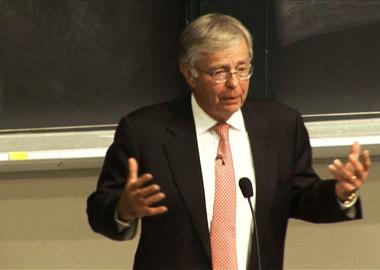 Returning to his freshman physics classroom after half a century, Kent Kresa still feels passionate about MIT: “It’s a place I love; I feel good when I come back, and it’s been very much a part of my life for the past 50 years.” In his talk, Kresa describes how an MIT education helped shape his professional path, leading to a topflight career in the aviation and defense industry.
Kresa came to MIT “in love with airplanes,” but had no sense where he’d end up. Fascinated by fluid dynamics, he found student work at Boeing in the wind tunnel group. After witnessing “huge open rooms that had acres of engineers…all grinding away on numbers,” he left Boeing with “serious questions about his future career” in aeronautics engineering. He was so soured that he contemplated leaving MIT for a business degree at Harvard.
MIT professors persuaded him that the engineering world was about to change dramatically, and Kresa decided to stick it out. This decision paid off, for Kresa soon found opportunities that were both exciting and cutting edge. He got an early taste of digital computing at a firm
For more techical information visit our sister website www.engineeringmaintenance.info or for equipment procurement please visit www.engineeringtrader.com

Returning to his freshman physics classroom after half a century, Kent Kresa still feels passionate about MIT: “It’s a place I love; I feel good when I come back, and it’s been very much a part of my life for the past 50 years.” In his talk, Kresa describes how an MIT education helped shape his professional path, leading to a topflight career in the aviation and defense industry. Kresa came to MIT “in love with airplanes,” but had no sense where he’d end up. Fascinated by fluid dynamics, he found student work at Boeing in the wind tunnel group. After witnessing “huge open rooms that had acres of engineers…all grinding away on numbers,” he left Boeing with “serious questions about his future career” in aeronautics engineering. He was so soured that he contemplated leaving MIT for a business degree at Harvard.
MIT professors persuaded him that the engineering world was about to change dramatically, and Kresa decided to stick it out. This decision paid off, for Kresa soon found opportunities that were both exciting and cutting edge. He got an early taste of digital computing at a firm
developing a commercial parachute system for satellite capsules. He worked at MIT Lincoln Lab in ballistic missile defense. One of his most “phenomenal life experiences” unfolded on a tiny atoll in the Marshall Islands, where he and a team of 100 MIT researchers toiled for two years on a missile reentry project. Cut off from the rest of the world, there wasn’t “a lot to do other than to work and drink and party.”
After completing an advanced MIT engineering degree in the mid-60s, Kresa went to work for DARPA. He saw the first stirrings of the internet, and the evolution of infrared technology, precision weapons guidance, GPS, stealth technology and unmanned vehicles. After seven years in this innovative environment, Kresa feared he “had peaked before he was 35.” But his next job “fortunately proved there was plenty left to do.” He headed to Northrop as lead researcher, which led to a series of increasingly senior positions, culminating in company chairman in 1990.
At Northrop, Kresa weathered the downsizing of the nation’s defense industry, which spurred his company’s acquisition of Grumman and other affiliated tech companies. He says he came to recognize that “engineering-related activities that emphasize broad thinking and innovation have the best chance of delivering good solutions and giving self-fulfillment and social value as well.” These insights, he says, powerfully evoke his MIT experiences, where he first learned that “the most successful problem-solving stretches and crosses boundaries,” and that the ideal environment for this involves “interaction with smart teammates, where everybody has mutual excitement about work, and the commitment to try out ideas.”...Read the full article/Watch Video
After completing an advanced MIT engineering degree in the mid-60s, Kresa went to work for DARPA. He saw the first stirrings of the internet, and the evolution of infrared technology, precision weapons guidance, GPS, stealth technology and unmanned vehicles. After seven years in this innovative environment, Kresa feared he “had peaked before he was 35.” But his next job “fortunately proved there was plenty left to do.” He headed to Northrop as lead researcher, which led to a series of increasingly senior positions, culminating in company chairman in 1990.
At Northrop, Kresa weathered the downsizing of the nation’s defense industry, which spurred his company’s acquisition of Grumman and other affiliated tech companies. He says he came to recognize that “engineering-related activities that emphasize broad thinking and innovation have the best chance of delivering good solutions and giving self-fulfillment and social value as well.” These insights, he says, powerfully evoke his MIT experiences, where he first learned that “the most successful problem-solving stretches and crosses boundaries,” and that the ideal environment for this involves “interaction with smart teammates, where everybody has mutual excitement about work, and the commitment to try out ideas.”...Read the full article/Watch Video
For more techical information visit our sister website www.engineeringmaintenance.info or for equipment procurement please visit www.engineeringtrader.com
